
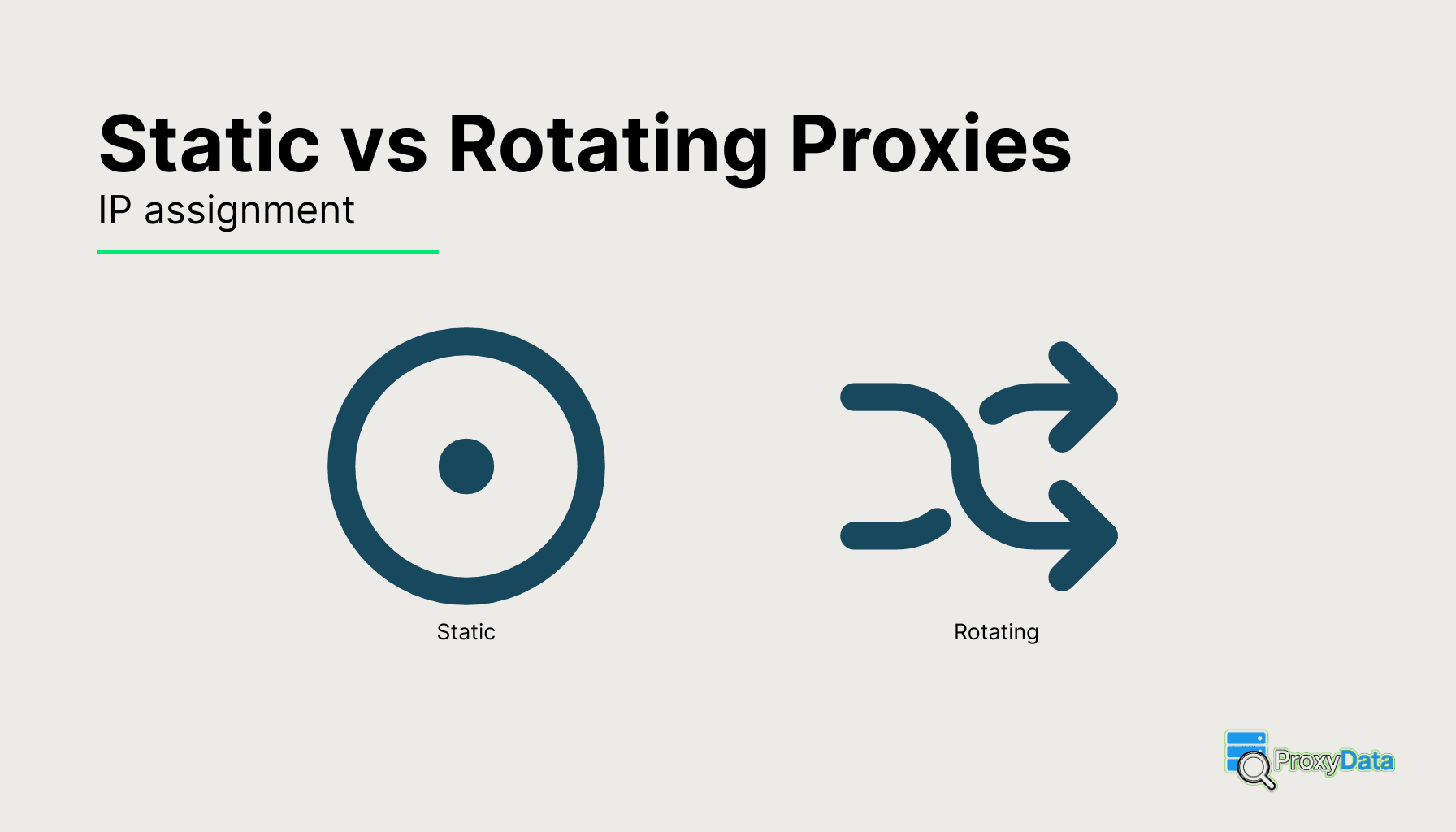
Choosing between static and rotating proxies comes down to how your IP identity changes over time and who controls those changes. For a full map of network options, see our overview of proxy services; here we focus on the static vs rotating choice.
Static vs rotating: what is the difference
Static keeps the same egress IP until you replace it yourself, while rotating switches the IP per request or after a timed window via a gateway. Sticky options in rotating networks hold one IP temporarily to finish short flows.
Static gives you full control over swaps and inventory. Rotating outsources churn to a provider’s pool, controlled by session keys or rotation ports.
Key differences at a glance
| Dimension | Static proxies | Rotating proxies |
| Identity persistence | Long-lived until manual swap | Changes by request or interval; sticky holds briefly |
| Control surface | You pick and schedule IP changes | Gateway selects IPs from a pool using rules |
| Detection profile | Consistent history per IP | Mixed history across pool members |
| Scaling style | Add more IPs and threads | Use pool size, concurrency, and rotation |
| Typical billing | Per IP, port, or thread | Often per GB, sometimes port or request |
| Ops workload | Manage lists, warmups, replaces | Tune rotation mode, sessions, concurrency |
| Best fit | Multi-step, stateful sessions | Wide fan-out and strict rate limits |
When to use static vs rotating
Use static when a site ties actions to session continuity or device tokens and you must keep one IP for the whole flow. Use rotating when the blocker is rate limits and you need many attempts across fresh identities.
If you need short persistence, pick rotating with sticky sessions and set a TTL that matches task length.
Rotation types: by request vs by interval
Per-request rotation assigns a fresh IP on every connection, which maximizes spread and parallelism. Interval rotation keeps one IP for a fixed time, which reduces churn and looks more like a normal session.
For modes, examples, and tuning tips, see the guide to proxy rotation types.
Sticky sessions: short-term persistence
A sticky session binds a session key or sticky port to the same IP for a limited TTL, then releases it back to the pool. This gives you “just enough” continuity for carts, checkouts, or short forms.
Implementation details and pitfalls are covered in the sticky sessions guide.
IP pools and gateway endpoints
Rotating networks expose a gateway that draws from an IP pool. Pool size, sourcing, and gateway policy set the real concurrency you can run without burning through fresh IPs too fast.
Pool structure and gateway parameters are explained in proxy IP pools and gateway endpoints.
Throughput and concurrency limits
Throughput on static scales with the number of assigned IPs and per-IP connection caps. Throughput on rotating scales with pool size, gateway concurrency, and rotation policy.
Track effective requests per second per destination, not just global totals. Cap parallelism per host to avoid cascaded blocks and waste.
Billing models and cost control
Static plans are usually per IP or per port, which is predictable for long sessions. Rotating plans are often per GB, which is flexible for bursty work but punishes heavy payloads and retries.
Watch average bytes per success and block share by code. Reduce wasted traffic with early stops on anti-bot responses and response compression where possible.
Setup patterns and examples
Static access is a list of endpoints you schedule and replace on your side. Rotating access is a backconnect gateway with parameters for rotation and stickiness.
Common patterns:
- Static endpoint
http://username:password@198.51.100.23:8000 - Rotating by request
http://username:password@gw.provider.com:10000 - Rotating sticky session
http://username:password@gw.provider.com:10000?session=cartA - Rotating by interval via port map
gw.provider.com:10100 where port encodes rotation period
FAQs
Is sticky rotation the same as static?
No. Sticky holds one IP only for a TTL or until you drop the session. Static keeps the IP until you manually change it.
Can I mix static and rotating in one workflow?
Yes. Run static or sticky for stateful steps and a rotating pool for wide discovery, each with separate clients and limits.
Why did rotating get blocked faster for me?
Usually due to high parallelism per destination, reused session keys, or a pool with weak hygiene. Throttle by host and refresh sessions correctly.
When does per-GB pricing hurt?
Large payloads and high error rates. Compress responses, cut retries on repeated block codes, and measure bytes per successful action.
Do I need sticky if my tasks are very short?
Not always. Per-request rotation can be enough for single-shot calls. If a step needs cookies or device tokens to persist, add sticky with a TTL that matches the step.