
IP Sourcing
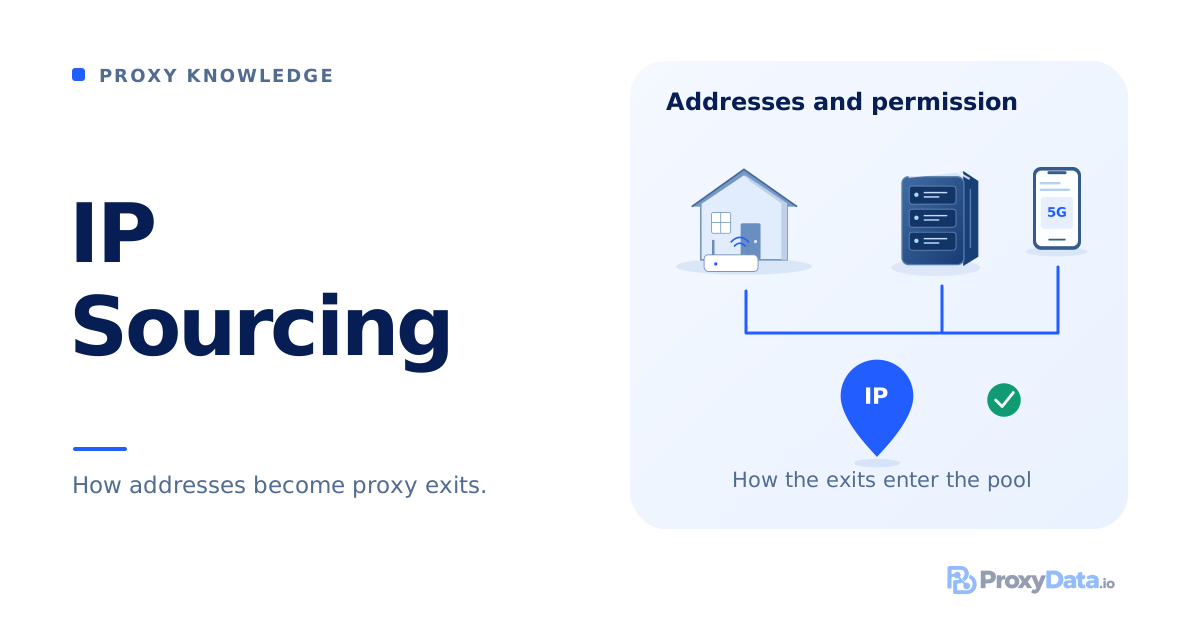
IP sourcing covers the ways a proxy provider obtains IP addresses and connections for its network, along with permission to use them to carry customer traffic.
Sourcing practices are one aspect of provider policies. A proxy on sale may be backed by a rented server, an internet service provider's address range, a participant's home computer, or a modem with a SIM card. For the buyer, the service starts with a connection address and credentials. But the origin of the exit affects how long a session lasts, why its IP changes, who else can use that address, and how much control the provider has over the service.
In the second half of 2026, commercial proxy networks use their own infrastructure, leased address ranges, agreements with network operators, applications on user devices, and wholesale suppliers. A single service may combine several of these sources.
What sits behind different proxy types
| Proxy type | Where the exit IP comes from | Where the outbound connection is handled |
|---|---|---|
| Datacenter | Address space held by a hosting company, the proxy provider, or a third-party lessor | On a server in a data center |
| ISP | Addresses obtained through an agreement with an internet service provider or through a supplier | Usually on continuously running server infrastructure |
| Residential | A participant's connection supplied by a home broadband or other subscriber internet provider | On the participant's device |
| Mobile | A cellular operator's connection | On a user's smartphone or a provider-managed modem, router, or phone |
Each model has its own supply chain. The company named in an IP's registration records, the owner of the hardware, and the proxy seller may be different organizations. That difference is normal in itself: addresses and infrastructure can come from different suppliers.
Datacenter proxies
Purchases, leases, and servers with addresses
A provider can obtain datacenter IPs in several ways.
Address space registered to the company. It may have been allocated previously or obtained through a formally recorded transfer from another organization. Regional Internet Registries, such as the RIPE NCC and ARIN, register and distribute resources under their respective policies. Local Internet Registry, or LIR, status allows an organization to work with these resources, but does not provide unlimited access to new IPv4 addresses. The RIPE NCC, for example, uses a waiting list for remaining and recovered addresses.
Leasing a range from its holder. A network operator, hosting company, or another organization may have unused address space. A proxy provider leases it directly or through a specialist marketplace. This allows the provider to expand its pool without buying the entire range.
Renting servers together with IPs. A hosting company supplies the hardware, internet connectivity, and addresses. The proxy service installs the required software and sells access to customers.
These arrangements can also be combined: servers are rented from one company and IPs from another. If the infrastructure supplier supports externally sourced address space, the leased range is connected to those servers. This approach is known as BYOIP, or Bring Your Own IP.
How a leased range becomes working proxies
Consider a /24 block containing 256 IPv4 addresses. Its holder authorizes the proxy provider to use the range, and a data center connects it to the server infrastructure.
The service needs both permission to use the addresses and correct routing: the internet must know which network can reach the range. Route announcements are exchanged using BGP.
Permission to announce a range may be documented in a Letter of Authorization, or LOA. RPKI provides another mechanism: a Route Origin Authorization, or ROA, identifies the autonomous system, designated by its ASN, that is authorized to announce the address block. These mechanisms help confirm routing authorization. They do not establish an IP's reputation on a particular website.
Registration records, abuse contacts, and geolocation information are maintained separately. For example, a geofeed lets a network operator publish a mapping of address ranges to countries and regions. Geolocation databases may consider this information alongside other sources; publishing the file does not make every website immediately accept the stated location.
What the range's origin means for the buyer
A leased range remains subject to the lease terms. When the agreement ends, its holder can require the lessee to stop using the addresses. ARIN explicitly notes that leasing does not give the lessee permanent registration rights. For a proxy customer, this may mean receiving a replacement IP list even when the service's hardware is working properly.
There is also a dependence on upstream infrastructure. A complaint may reach the hosting company or the address holder. The proxy service then has to resolve the issue to retain network access. Registration databases provide contacts for abuse matters; the RIPE Database uses the abuse-c attribute.
Correct registration says nothing about how a range was used previously. An IP assigned exclusively to a customer may have had earlier tenants. In a shared pool, other users' actions can change an address's reputation.
Lawful acquisition, address history, and exclusive use are separate properties of the service.
ISP proxies
Where internet service provider addresses come from
In a common commercial model, ISP proxies use addresses associated with an internet service provider and operate on server infrastructure. Keeping the connection available therefore does not depend on someone leaving a home computer switched on. This product is also marketed as Static Residential.
Addresses can be obtained through direct cooperation with an operator or through a supplier that already has suitable ranges and connectivity. Commercial services explicitly describe working with ISPs and hosting these proxies in data centers.
The supply chain may include:
- a large operator with its own address space;
- a regional internet service provider supplying some of its available resources;
- a wholesale supplier bringing together offers from several networks;
- a seller obtaining operational proxies from another service.
For buyers, this explains why ISP proxy availability can be uneven. Access to a particular operator's addresses depends on commercial agreements and available infrastructure. A dashboard setting cannot produce an unlimited supply of ISP proxies in any country.
Why a server-based exit is classified as ISP
An address block has a registration history and network associations. The servers running the proxy may be located in a data center while an internet service provider supplies the addresses they use.
Some deployments connect the server site to the operator's network through a tunnel, such as GRE, which carries packets between networks. GRE itself does not encrypt the contents or guarantee that a website will treat the connection as residential. Policy-Based Routing, or PBR, can select a route for particular traffic, but does not itself create the characteristics of an ordinary user.
Naming an operator in registration records also does not require every system to classify an IP in the same way. Different databases use their own information about the network and how its addresses are used.
What the customer is paying for
The value of this model comes from combining operator-network addresses with infrastructure that the provider can maintain continuously. This makes it possible to use one exit IP for an extended period without depending on the actions of a household device's owner.
The ISP label does not guarantee a particular speed, freedom from blocks, or exclusivity. ISP proxies may be dedicated or shared among customers. The product and plan determine those conditions.
Pricing depends on the operator, country, available address supply, and supply agreement. There is no universal rule such as “always three times the price of datacenter proxies.”
Residential proxies
How a user's device joins the network
To provide a residential exit, the provider needs access to a participant's connection. Software on the device receives tasks or forwarded traffic and establishes connections to target websites over the available internet link.
There are several ways to recruit these devices.
Bandwidth-sharing apps that pay users. A person installs an application specifically to receive compensation for sharing part of their internet connection. Payments may depend on demand for that location, the amount of traffic transferred, and the program's rules.
An SDK inside another application. A developer adds the proxy network's software module to a game, utility, or another product. The user receives additional features, fewer ads, or another benefit, while the developer receives payments from the network operator. The application continues to perform its main function.
Voluntary resource-sharing networks. A participant provides a connection in exchange for service features. Such a network can use its own application or the same SDK approach: these methods can overlap.
Partner pools. The seller obtains access to devices through another company. The buyer deals with one brand, while a supplier handles participant recruitment, software, and part of the infrastructure.
What users should understand when joining
Transparent participation means that a person understands that:
- other customers' traffic will pass through their device;
- their internet connection will be used;
- they receive a specific payment or feature;
- they can stop participating;
- resource usage is subject to defined limits.
A separate consent screen and an accessible opt-out give users a chance to make an informed choice. Commercial SDK documentation describes these mechanisms. Permission to use the connection also matters: a personal laptop may be connected to an employer's, hotel's, or another party's network. Bandwidth-sharing program terms may require the network owner's permission and compliance with the internet service agreement.
The module's operation is not always obvious from the application's appearance. Visibility depends on the implementation: it may provide a status screen, a participation switch, or a system-tray icon. Device heat or battery consumption alone does not establish that a proxy is running.
Who experiences the consequences of other people's traffic
The target website receives requests from the network participant's address. The consequences can therefore affect that person's own internet use.
Published bandwidth-sharing terms explicitly warn about CAPTCHAs and temporary loss of access to certain services for the connection owner. This is a concrete reason why customer screening, load limits, and complaint handling also matter to the people supplying their devices.
For the buyer, a different dependence arises: the participant can switch off the device, remove the application, or withdraw consent. A residential network changes continuously. A sticky session helps reuse an available exit, but cannot keep a disconnected device online.
Mobile proxies
With mobile proxies, the outbound connection uses a cellular operator's network. It can be supplied by user devices or by purpose-deployed equipment.
Participants' smartphones
An application or SDK uses the participant's cellular connection. The provider selects available devices on the required network and routes customer traffic through them.
The actual exit connection matters. A smartphone connected to home Wi-Fi usually uses the home internet provider's address. A mobile exit is created when traffic is sent over the cellular network.
Availability depends on signal, application state, operating-system restrictions, and the owner's actions. For example, one commercial iOS SDK explicitly states that it operates only while the containing application is visible on screen. This shows how much participation conditions can differ between platforms.
The provider can switch a customer between available devices. However, retaining a particular exit for an extended period depends on how long that device remains available.
Modem farms
The second model uses equipment managed by the provider or its partner: USB modems, cellular routers, or phones with SIM cards. These devices connect to management infrastructure that supplies proxy access to customers.
This product can let a customer rent a particular modem for a set period. Management tools allow reconnection manually, through an API, or on a schedule. Hardware-based mobile platforms document these capabilities.
The provider has better control over power and equipment state than it does over independently operated user devices. Speed and availability still depend on the mobile operator, signal, network congestion, and the SIM plan's terms.
Reconnecting does not guarantee a new IP on every attempt. The operator's network controls the public address. Existing connections may be interrupted during reconnection, and the new exit can sometimes have the same address as the previous one. Hardware-service terms may explicitly exclude any guarantee of a particular IP or range.
Why a dedicated modem can have a shared IP
Cellular operators use CGNAT, which allows multiple subscribers to reach the internet through a shared public IPv4 address. RFC 6598 describes the special 100.64.0.0/10 address space reserved for use in service-provider networks.
A customer can therefore have exclusive use of a rented modem while sharing its public IP with other subscribers of the mobile operator. Exclusive hardware and an exclusive external address are different properties.
Shared use creates an advantage for a mobile exit: blocking the entire IP may affect ordinary subscribers. However, website defenses can assess individual sessions and requests, so CGNAT does not make a connection immune to blocking.
Per-gigabyte billing is more common for distributed pools, while time-based rental is common for dedicated equipment. The billing method alone does not establish how the network is built.
When a network's origin becomes a problem
Consent can be clear, hidden, or absent
A transparent network explains participation before enabling it and provides a working way to opt out. Problems arise when connection sharing is buried in general terms or not disclosed at all.
In the worst case, a device is enrolled without permission through malware, a hidden application component, or preinstalled unwanted software. Its exit address can still belong to a real home internet provider.
Investigations document this problem. A Google Threat Intelligence Group study published in 2026 described more than 600 applications from different distribution sources containing code that communicated with the proxy infrastructure under investigation. Many performed ordinary game and utility functions while also enrolling devices in a proxy network without clearly disclosing that function.
A real residential IP does not, by itself, establish the device owner's consent.
An IP checker does not verify consent
A database may identify the operator, an estimated location, or an address's association with a known proxy network. A security system may detect suspicious behavior or characteristics of a TLS connection or browser.
Those signals do not directly reveal whether the device owner saw a consent screen and voluntarily opted in. A willing participant's device and a malware victim's device can be on the same operator's network.
Sourcing is therefore assessed through information about suppliers, applications, and enrollment procedures. Reputation and automation detection are assessed separately. Cloudflare's documentation, for example, describes the analysis of request, browser, and session characteristics; those characteristics do not establish the exit owner's consent.
Suppliers, resale, and overlapping pools
A proxy provider may recruit network participants itself, buy access to another company's pool, or combine both approaches. Different brands therefore do not always mean independent infrastructure.
A public IP may appear at several services for different reasons: shared suppliers, multiple installed applications, or several devices sharing one address. Public tools for checking whether an IP participates in proxy networks also describe these possibilities.
For buyers, this creates a practical limitation: buying from a second seller does not guarantee an entirely new address pool. Nor does it always protect against an outage at a shared supplier.
Dependence on partners can significantly change a network's size. One large operator publicly reported ending agreements with two SDK partners that supplied more than 10% of its residential network because they did not meet its security requirements. This is the operator's own account, but it illustrates the scale of dependence on individual sources.
When comparing pool sizes, it also matters what is being counted:
- addresses observed over a particular period;
- devices that have ever connected to the network;
- exits available right now;
- IPs in a particular country or operator's network.
These measures are not interchangeable. One device can use different IPs over time, while several devices can simultaneously share one public address.
What supports sourcing transparency
Different proxy types require different evidence.
| Evidence | What it helps establish | What it does not establish |
|---|---|---|
| WHOIS/RDAP registration records | The organization listed for an address resource | Who sells the proxy or currently uses the address |
| An address-range or supply agreement | The terms under which addresses or network access are supplied | That every target website will accept those IPs |
| LOA and RPKI/ROA | Authorization for the relevant network to announce a range | A clean address history or the device owner's consent |
| An enrollment screen and a working opt-out | How a user authorizes and ends participation | That every partner always follows the same procedure |
| Supplier and application reviews | How the provider controls the addition of new exits | The absence of all future violations |
| An independent auditor's report | What was examined, within the stated scope and period | Automatic confirmation of every marketing claim |
Certifications also have a defined subject. SOC 2, for example, concerns controls related to security and other stated system characteristics. Establishing whether proxy exit sourcing was examined requires a relevant audit scope. A website badge alone does not establish that.
Customers rarely have access to all the commercial agreements and internal network records. Even so, a meaningful description of sourcing helps explain who supplies the addresses, who operates the devices, how participant consent is obtained, and what happens when suppliers violate requirements.
What IP sourcing changes about the service
For datacenter proxies, the stability of the address supply depends on infrastructure and rights to the ranges in use. ISP proxies also depend on agreements with operator networks. Residential proxies depend on user-device availability and the quality of enrollment procedures. Mobile proxies add the constraints of cellular networks, SIM plans, and hardware management.
These differences explain why one service can retain an IP for a long period, another continually changes its available exits, and a third sells a dedicated modem without promising an exclusive public address.
Well-managed IP sourcing gives a provider clear rights to resources and a supply chain it can manage. For buyers, this supports a predictable service. Compatibility with a target website, IP history, and plan terms remain separate characteristics that address sourcing helps explain, but does not replace.