
Proxy Geolocation Mismatch
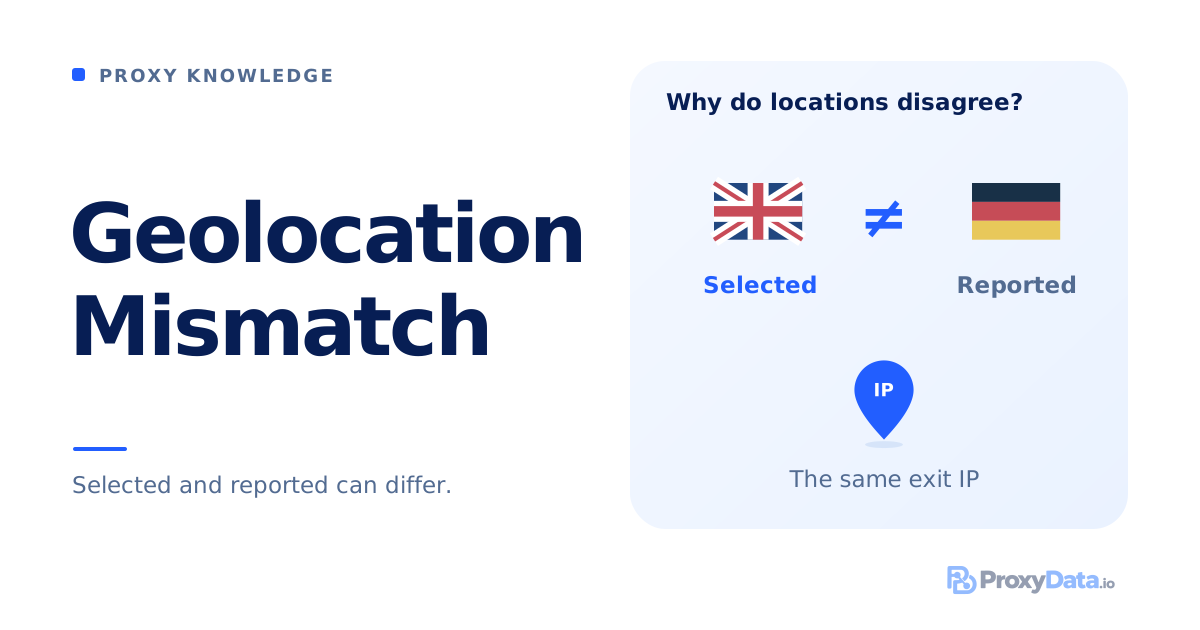
Proxy geolocation mismatch is a difference between a proxy's advertised or selected location and the location that a website or IP geolocation database assigns to its exit IP. The disagreement can concern a country, region, or city.
Location selection is part of Proxy Geolocation & Targeting. For the buyer, the problem can first appear on the website they want to use: it places their connection in another region, without explaining where its location information comes from.
Websites can obtain this information from IP geolocation databases, which associate IP addresses with estimated locations. MaxMind is one of the leading providers in this field. Its GeoIP data are used by websites and applications whose visitors may never see the company's name. A particular site may instead use another supplier or its own data; the source is not always disclosed.
An address range with a history
Consider a customer who buys a datacenter proxy advertised as Japanese, while the target website assigns the connection to the United States. For this example, assume that the website uses MaxMind data. These countries illustrate a problem that can arise with other locations too.
Behind the offer is a leased IP range previously classified as American. The provider sets aside part of it for the Japanese service and, directly or through the range's holder, records the relevant assignment and country information in the address registry. In this example, the entry in the RIPE Database, operated by RIPE NCC, now lists Japan. The changes are made by a party authorized to maintain the records.
RIPE NCC is one of the regional internet registries that administer address resources. Others include ARIN and APNIC. The relevant registry depends on where the address space is registered, and the procedures and available fields differ.
Support now has a registry entry to cite. However, updating registration information does not update every geolocation database. The commercial GeoIP supplier maintains its records separately, so the country in MaxMind can remain unchanged.
Nor does changing a country field move a server. Equipment may actually have moved, or the service may offer a virtual location whose label differs from the equipment's physical location. The registered country is part of the explanation, but it is not independent proof of physical placement.
Why the website sees a different country
MaxMind does not simply copy the country in a registration record. It maintains its own location estimates and reviews proposed changes against multiple sources of information. It also explicitly distinguishes geolocation from the country recorded in WHOIS, a service for looking up registration information.
The previous country could be left over from the range's earlier use. It could also reflect information that the geolocation supplier still considers more persuasive than the newly declared location. These are different situations: an outdated record may need refreshing, while a disputed location may remain disputed after review. Waiting alone does not necessarily resolve either.
The disagreement becomes visible wherever those data are used. A website and a checker using the same supplier may both assign the address to the same unexpected country. The customer sees the website's decision, even if the geographic classification originated with another company.
When the customer's work depends on that site, its classification matters. The location shown in the proxy dashboard cannot override the result used by the website.
A website's language, currency, or access refusal can also have causes unrelated to IP geolocation. In the example above, the assumed cause is specifically the country associated with the exit IP in the site's geolocation data.
Where support reaches its limit
The customer asks for a replacement. Support sends another address from the selected pool, but the target website still places the connection in the wrong country. If the replacement falls under the same geographic record, the reason for the complaint remains.
Support can look for another range that the relevant source places in the required country. The provider or its network operator can also submit evidence for a correction. One way to supply location information is a geofeed, a published file that associates address ranges with places.
Neither action is a switch that forces the desired country to appear. MaxMind may accept or reject a correction. If a change is accepted, websites using downloaded copies of the database still need to receive and apply the newer data. A submitted request is therefore not a promise that the customer's problem will disappear by a particular date.
The provider may also have no suitable alternative. It has a pool advertised for the selected location, but none of the available addresses satisfies the customer's requirement. Repeated replacements from that pool will not create the missing supply. The dispute has become a question of product availability: the remaining option may be another product or another provider.
That limitation should be stated plainly. The seller still needs to be clear about what its location label means and what it can deliver. Registration evidence does not make an unsuitable proxy useful to the buyer.
Residential networks and location availability
For a customer who needs a particular location, a residential service can offer another route. In a pool built from participating users' connections, the exit can be a device connected through a household internet service in the required country. The connection's geographic basis comes from the local network being used, rather than a recently changed registration label on a datacenter range.
This is why moving to a residential network can be more productive than requesting one more replacement from a datacenter pool that has no suitable exits. A country that is difficult to obtain in a low-cost fixed-address package may still be available through local residential connections.
Geolocation errors remain possible, especially at city level. But a residential provider with suitable exits in the required country gives the buyer another supply of addresses instead of another argument about the same range.
The change can be expensive. Many residential services charge for traffic, while a fixed datacenter package may charge for a set of addresses over a subscription period. A workload that is inexpensive on a bulk datacenter package can cost substantially more when the downloaded traffic is metered. There is no single price multiplier: the volume of work and the plan determine the difference.
The buyer may accept that cost and finally obtain an IP that the target site places in the required country. Then another requirement appears: can this exact address remain available tomorrow, next week, or for the rest of the project?
The same country is not the same IP
A residential pool can keep supplying exits in the chosen country without keeping one particular address assigned to the customer.
The household connection belongs to someone else. The device may go offline, its internet connection may reconnect, or its public address may change. The proxy service can offer a sticky session, which tries to retain the selected exit for a stated period, but that does not turn a participating device into a permanently reserved server.
A session advertised as lasting up to a certain time can end earlier if the exit becomes unavailable. Depending on the product, subsequent requests may receive another exit or fail instead. The next available IP may still be in the required country: the country requirement is satisfied, while the requirement to keep the same address is not.
For a short visit to a regional website, this may be acceptable. For an application that relies on one fixed address over a long period, it changes the suitability of the service. A rotating residential pool is not a dependable substitute for a long-term address reservation merely because it offers sticky sessions.
That distinction is easy to miss when the original problem is described only as “I need proxies from this country.” It can mean a succession of usable exits in that country, or it can mean one specific IP that remains assigned. Those are different purchases.
Where ISP and mobile proxies fit
A static ISP proxy is a more relevant option when retaining the address matters. These products use ISP-assigned address space and can be operated on servers with a fixed address allocation. They are also sold under the name static residential proxies, which can make them easy to confuse with sessions in a rotating residential pool.
The useful feature here is the product's fixed assignment. The word ISP by itself does not guarantee the required location, availability in a particular city, or an address reserved indefinitely. A service must actually have a suitable exit in the required location and offer the required retention period. The combination narrows the choice; it cannot be assumed from the product name.
Mobile proxies provide another possible source of exits through a mobile operator's network in the required country. They may suit the location requirement, but a mobile connection is not automatically a fixed public IP. The address can change, and session controls remain subject to the service and the network. Keeping the same address for weeks needs an explicit product commitment, not an assumption based on the word mobile.
The customer who needs a hard-to-find location, one unchanged address, and a low bulk price is asking for three separate properties. Some datacenter services may be able to supply that combination. When a particular provider cannot, paying more for residential access may solve the country problem while leaving address retention unresolved. A suitable static ISP or other explicitly fixed-address product may meet both needs, if it is available.
An incorrect geographic record can sometimes be corrected, making the existing proxy usable. But if the provider cannot supply the required combination of location and address stability, the problem will not be solved by another explanation of WHOIS. It requires an offering that actually has those properties.