
Proxy Logging and Privacy
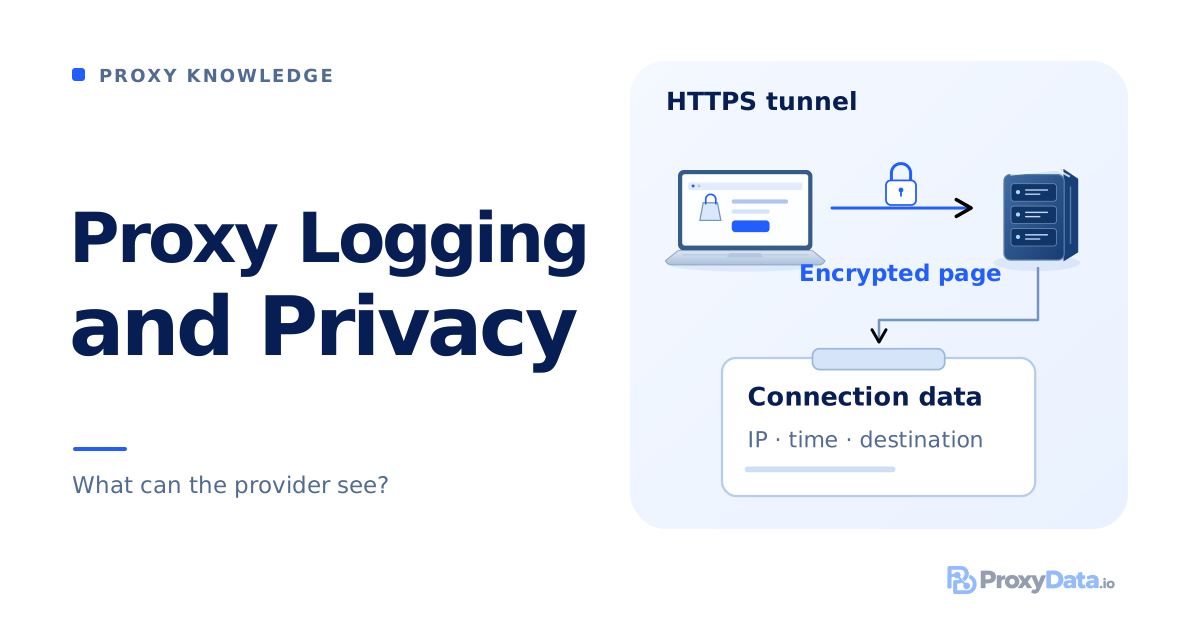
Proxy logging is the recording of information about how a proxy service is used: who connected, when, where the connection went, how much data passed through it, and sometimes the requests and responses themselves. Within Provider Policies, the privacy policy explains which of these records the company collects, why it keeps them, and who can receive them. Hiding your IP from a website does not hide your account from the company carrying your traffic.
In the second half of 2026, commercial proxy services include ordinary network tunnels, products that inspect HTTPS, and managed tools that fetch entire websites for customers. These services give their operators very different access to data. A promise such as no logs is useful only when it identifies the product, the information excluded from storage, and the records that remain.
What a proxy provider can see
Consider a request to https://shop.example/orders/742. An ordinary HTTPS tunnel can reveal a connection to shop.example:443, while the page path /orders/742, the order details, cookies, and response stay inside the encrypted connection between your application and the website. TLS, the security protocol used by HTTPS, provides that protection.
The provider can still associate the connection with your proxy account, count its bytes, and record its timing. An unreadable page can leave a readable connection history.
| How the request is handled | What is available to the service | What stays protected from it |
|---|---|---|
| Plain HTTP through a proxy | Destination, page path, query parameters, HTTP headers, and request and response bodies | HTTP provides no encryption for this exchange. |
| HTTPS through a normal HTTP CONNECT or SOCKS5 tunnel | Connection metadata; destination IP and port; the domain when disclosed during connection setup | HTTP headers, page path, query parameters, and content, with correctly verified TLS and no interception |
| HTTPS inspected using a trusted interception certificate | The decrypted HTTP request and response, in addition to connection metadata | Only data separately encrypted above HTTPS remains unreadable to the inspecting component. |
| A Scraping API or remote browser fetches the page | The task you submit, the request the service makes, and the content it retrieves | Information you never send to or process through that service |
The difference can exist within one provider's catalogue. Switching from its regular proxies to its managed scraping product changes how much of your work the service can inspect.
Provider certificates and HTTPS inspection
An instruction to install a provider's root certificate can look like a minor setup requirement. When that certificate is used for HTTPS inspection, it changes who can read the traffic.
A root certificate identifies a certificate authority, or CA, that your application agrees to trust. In an inspection setup, the intermediary uses its CA to sign certificates for the websites you visit. Your application accepts those certificates because you have granted that trust.
There are then two encrypted connections. Your application sends its request to the inspecting intermediary, which decrypts it. The intermediary establishes a separate HTTPS connection to the real website, receives the response, and returns it over its connection to you. The traffic is encrypted on both network links, but readable where those links meet.
This can expose full page paths, search queries, submitted form fields, authorization headers, session cookies, and downloaded pages. An ordinary tunnel cannot read your website password inside HTTPS; an inspecting component can read it if your application sends it through that connection. Data encrypted separately by the application remains a different case.
This visibility has operational purposes. Managed tools use it to inspect responses, apply rules, handle blocked pages, and produce structured results. It can also support enforcement: a service able to examine requests can assess whether their contents and methods match an approved use case. Commercial network policies already describe restrictions based on approved targets and methods. Content visibility gives the service more control over your requests. That is a material part of the product customers are agreeing to use.
The scope matters. A CA trusted only by a scraping script has a narrower reach than one added to a system-wide trust store. Installation alone does not send every application through the provider, and some applications use separate certificate stores or certificate pinning. Also, an inspection tool running on your own machine does not, merely by decrypting locally, prove that the provider receives its logs.
There is another certificate distinction: verifying the proxy server's own HTTPS address is different from allowing the intermediary to issue certificates for destination websites. The former secures your connection to the proxy. The latter enables inspection when the traffic is routed through that component.
Disabling certificate verification to make an error disappear gives up the check on who is answering. It does not restore privacy. For a managed product, the sensible choice is to understand the trust being requested and keep it confined to the intended workload.
Scraping APIs and remote browsers
With a Scraping API, you hand the provider a task: retrieve this URL, use these options, and return HTML, JSON, or a rendered result. The provider becomes the client that visits the website. It receives the page in readable form because that is necessary to do the work.
The remote browser is a browser running on the provider's server, controlled through your app or an API. It loads the website there, so pages, scripts, cookies, and sessions are processed in the provider's environment. Your connection to that browser can be encrypted while the service still has access to the task and its results.
HTTPS inspection, a Scraping API, and a provider-hosted browser all give the provider access to page content, but by different routes. Inspection ends your HTTPS connection at the intermediary. The managed tools make their own connection to the site after you submit a task. A Scraping API can therefore have this visibility without asking you to install a provider certificate.
This access is part of the work these products perform. An API cannot return a page or extracted data without receiving the website response; a hosted browser must process the page to display it. Technical access does not establish that employees routinely inspect customer tasks, that every page is saved, or that data is shared with others. Processing, persistent logs, and staff access are separate questions; managed products may also have retention terms different from ordinary proxy traffic.
Depending on the product, the information supplied can include full URLs, search terms, custom headers, cookies, POST bodies, location settings, and instructions for interacting with a page. Anything the tool does not support cannot be assumed to be accepted. But the items you do supply should be treated as information entrusted to that service.
For a business, the sensitive material may be its list of monitored products, a sequence of searches, or access tokens for a permitted task. None needs to be a password to have commercial value. Outsourcing page retrieval also gives the service visibility into that part of your workflow.
Connection records and no-logs claims
The word “logs” can mean several different datasets. Customers often hear “no logs” as “no record of my activity exists anywhere.” A provider may use it to mean that it does not retain page contents, while keeping records needed for operation, billing, and investigations.
The operational experience supplied to ProxyData for this article includes services that retain technical records despite public no-logs language. That experience matters: a marketing phrase should not be used as evidence that an account cannot be traced. Establishing a contradiction for any particular company still requires comparing its exact promise with the records it actually keeps.
| Record category | Possible contents | Why it matters to the customer |
|---|---|---|
| Connection and routing records | Timestamps, duration, incoming address, exit address, destination and ports, protocol, connection errors | Can connect network activity with a proxy account. |
| Usage and billing records | Bytes transferred, connection counts, plan, charges, usage summaries | Explain consumption and charges; may remain after detailed activity expires. |
| Account and security records | Email, sign-ins, subaccounts, credential changes, payment references, verification records | Link technical activity to the customer relationship. |
| Support and abuse cases | Tickets, attachments, third-party complaints, investigation decisions | Can contain information absent from the original traffic logs. |
| Request and result records | URLs, headers, bodies, retrieved pages, diagnostic samples | Can reveal business activity and secrets when the product has access to this content. |
These are possible categories, not a mandatory universal logging format. Public proxy activity documentation nevertheless provides concrete examples: timestamps, client addresses, destination hosts and ports, transferred bytes, and outbound source ports can all appear in customer-accessible records.
A published commercial privacy policy illustrates the wording problem particularly well: it excludes traffic contents and specific visited pages from logging, while explicitly listing target domains and connection metadata. Those statements can coexist. “No page contents” does not mean “no destination history.”
Nor does using RAM settle the issue. A temporary record is still processed information, and an in-memory record may be copied into another system. Conversely, keeping a bandwidth counter does not require preserving every individual destination. The useful questions concern the actual fields, their storage locations, and their lifetimes.
HTTP, SOCKS5, DNS, and domain visibility
HTTP CONNECT asks the proxy to open a connection to a host and port. For a domain-based request, the provider learns that name directly from the command. If the connection to the proxy itself uses TLS, the command is protected from observers on that link, but the proxy still reads it as the recipient.
SOCKS5 can receive a domain name, an IPv4 address, or an IPv6 address. When your client asks the proxy to resolve and connect to a hostname, it supplies that name. When it supplies an IP address instead, the SOCKS request does not necessarily identify the hostname. A single destination IP can serve many websites.
TLS can provide another clue: its Server Name Indication, or SNI, commonly reveals the requested hostname during connection setup. Encrypted Client Hello, or ECH, can protect that information when supported and used. It does not erase a domain your client has already disclosed in CONNECT, SOCKS, or a DNS request handled by the service. The claim that SNI is always readable is therefore too broad, as is the claim that HTTPS always hides the domain.
SOCKS5 itself does not encrypt the application traffic. HTTPS sent through SOCKS5 keeps its TLS protection; plain HTTP does not acquire encryption simply because it travels through SOCKS. Standard SOCKS username/password authentication also needs an additional protected transport to avoid exposing the proxy credentials on that link. Those credentials are separate from a website password carried inside HTTPS.
The incoming IP recorded by the proxy is the address of the peer connecting to it. For a direct customer connection, that is usually the customer's public address. With another intermediary in front, it can be that intermediary's address. A log field called “client IP” should be interpreted in the context of the route.
Traffic patterns and abuse investigations
An operator does not need to read a page to notice a sudden surge in bandwidth, thousands of simultaneous connections, or repeated attempts to reach one destination. Automated monitoring and administrators can use these signals to identify accounts requiring attention.
Such patterns can suggest brute-force attempts, abusive automation, a malfunctioning script, or unusual data transfers. Their meaning depends on context: a legitimate high-volume task and an abusive one can share some network characteristics. A complaint from the target can supply the missing evidence.
Managed services can also review a workload against restrictions on resale or approved business purposes. Many different sessions or tokens may prompt questions, but they do not by themselves prove hidden resale: agencies and teams can legitimately serve multiple clients. Whether that activity is permitted depends on the contract.
The target website sees the HTTP requests after terminating HTTPS at its end. It can report attempted logins, request paths, repeated errors, and timing. If the proxy provider receives that report, it can combine the target's evidence with its own connection records. The provider learning a request path through an abuse complaint does not mean it independently decrypted the original tunnel.
This also explains a common dashboard puzzle. A successful CONNECT response means the proxy opened the tunnel; the website inside it may still return a CAPTCHA, HTTP 403, or another error. An ordinary tunnel cannot read that encrypted response. An inspecting service or Scraping API can see it and report application-level results.
Shared proxies and account attribution
Sharing an exit IP with other customers does not make activity untraceable to the network operator. The operator may retain the mapping between each authenticated connection and the outbound connection it created.
In the service experience supplied to ProxyData, administrators routinely investigate abuse on shared proxies and identify the account involved. Their detailed records include timestamps with millisecond precision. Customers may dispute the finding, but the fact that the IP was shared does not invalidate a connection match.
For example, a target reports traffic from a particular exit IP, an observed source port, and a precise UTC time. The operator compares those details, together with the destination, against its outbound mappings and authentication records. The matching connection can lead back to a customer or subaccount even when many customers used the same exit IP that second.
Millisecond precision helps distinguish events, but accuracy comes from the complete match. Clock synchronization, source ports, destination information, retained mappings, and the quality of the complaint all matter. An exit IP alone may be insufficient when several customers share it.
A dedicated IP can be easier to associate with an account through its allocation history. Rotation changes addresses but can leave the authenticated account unchanged. Neither arrangement guarantees the absence of records.
Attribution to an account is also different from identifying the person who pressed a button. Employees, contractors, software, and someone using stolen credentials can all act through one account. That distinction is a reason to protect proxy passwords and access keys, even when the service successfully matches the traffic.
Retention, deletion, and backups
There is no single retention clock for an entire proxy service. Connection history, invoices, verification records, support cases, and scraped results can each have different lifetimes.
For a concrete published example, one provider sets connection-metadata retention at the active billing period plus up to 90 days, billing records at seven years, and account records at the subscription lifetime plus two years, subject to its stated deletion conditions. These are that provider's periods, not industry-wide defaults.
Customer-visible history is another matter. A dashboard or export API showing the last 30 or 90 days describes what you can retrieve there. It does not, by itself, establish when all internal copies are destroyed. Samples retained in support tickets or abuse cases may follow separate rules.
Closing an account also does not automatically erase every associated record. Where GDPR or similar rights apply, deletion requests must be assessed alongside exceptions such as legal obligations and the establishment or defence of legal claims. Records needed for those purposes can outlast the account.
Backup removal may follow a different schedule from deletion in a live system. Relevant privacy guidance allows for backup handling that puts deleted information beyond use until the backup is overwritten. “Deleted from the dashboard” and “removed from every retained copy” are different events.
Encryption at rest protects stored data against certain forms of unauthorized access. Replacing a name with an account number can reduce exposure. Neither makes records anonymous if the operator retains the means to connect them with a customer.
Staff, suppliers, and official requests
Privacy also depends on who can access the records. Support may need connection errors; finance needs payment information; an abuse investigator may need account and routing history. Access should follow defined roles, with records of administrative activity and restrictions on unnecessary content access.
A reseller and its upstream network can hold different parts of the picture. The reseller might have the customer relationship, while the network operator holds connection mappings. Payment processors, identity-verification companies, hosting services, and other contractors can also receive specific categories of data. A service description that mentions only the exit server leaves much of this relationship unexplained.
SOC 2 Type II reports and security certifications can provide evidence about controls within a defined scope. They do not automatically prove that no logs exist or that no employee can ever access customer information. For a privacy claim, the relevant detail is what was examined, during which period, and whether the product and logging practices fall within that examination.
Legal duties depend on the operator's jurisdiction, the type of service, and the applicable process. A demand to preserve existing records, a request to disclose information, and an obligation to retain specified data are distinct matters. The conditions should be read in the provider's policy and the applicable law; they cannot be reduced to one worldwide logging rule.
Providers may disclose information in response to binding legal demands and other legally permitted circumstances described in their policies. A court order is not the only possible procedure in every country. Cooperation clauses also do not establish that every authority has permanent direct access to the provider's systems.
The location of your purchased proxy is not enough to determine these rules. A Japanese exit IP can belong to a service contracted through a company elsewhere, with records processed in additional countries. The operating company and processing arrangements matter alongside the network location.
Business confidentiality and practical choices
Even destination metadata can be commercially sensitive. A collection of target domains, its timing, and the scale of access can reveal which market a team monitors or suggest an upcoming project. Full scraping instructions and results can expose considerably more.
For an ordinary HTTPS workload, a properly verified tunnel keeps the page contents between the application and the website. Choosing an inspected connection, remote browser, or managed API means entrusting that service with the data needed to perform the task. That can be a reasonable business decision when its access, retention, and contractual terms fit the project.
Credentials deserve particular care. Request logging should avoid or mask passwords, authorization tokens, and session secrets where possible. A customer can also reveal them voluntarily by sending a configuration file, screenshot, or browser network capture to support. Even a sanitized HAR export should be checked for sensitive URLs and bodies before it is shared.
Labels such as elite, private, dedicated, and residential do not define a logging policy. A public anonymity checker sees the request that arrives at its own website; it cannot inspect the proxy operator's internal records. Cryptocurrency payment and the absence of a passport check do not remove connection history either. Running a proxy on your own VPS gives you control over that proxy process, while hosting, billing, and destination-site records remain separate.
The most useful privacy promise explains five things: what the service can access, what it records, how long it keeps it, who can use it, and when it may disclose it. Those details tell a customer far more than an unqualified no-logs badge. HTTPS protects content within a particular connection; the architecture of the proxy product determines who stands at its ends.