
IPv4 Proxies
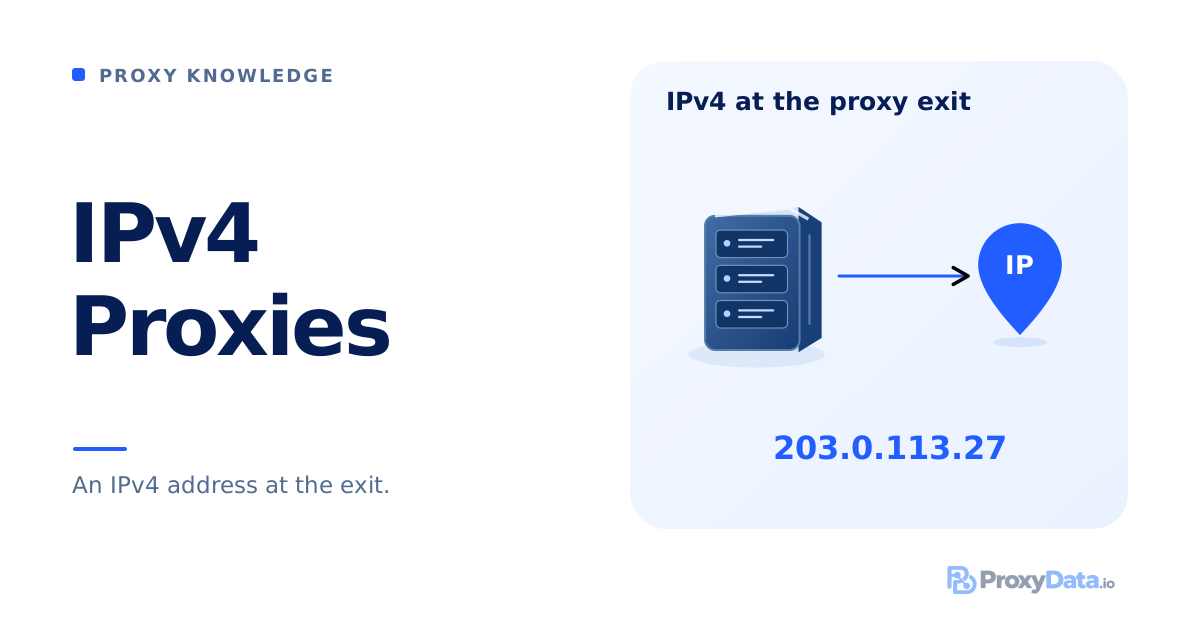
An IPv4 proxy is an intermediary that contacts a website on a client's behalf using an IPv4 address. IPv4 stands for Internet Protocol version 4. Its addresses are written as four numbers separated by dots, such as 203.0.113.27.
For a proxy customer, the IPv4 label primarily identifies the version of the exit address used to connect to the destination. The choice between versions is covered in IPv4 vs IPv6 Proxies. This article explains IPv4 itself: how to read an address, what a proxy customer receives, and why the same label appears on very different services.
What an IPv4 address looks like
An IP address is a numeric address used for network communication. Network equipment uses the destination address to decide where to send traffic.
The address 203.0.113.27 contains four numbers: 203, 0, 113, and 27. Each can range from 0 to 255. This means 203.0.113.300 is not a valid IPv4 address: its final number is outside the allowed range.
Each number occupies 8 bits in binary form. This block is called an octet. Together, the four blocks occupy 4 × 8 = 32 bits, which is why IPv4 addresses are described as 32-bit addresses. Dots make the four parts easier for people to read.
The numbers are not codes for a country, city, provider, and computer. For example, 203 does not identify a country, and 27 does not mean the twenty-seventh user. Network and estimated location information comes from separate data about the address.
The examples here use addresses from a range reserved for documentation. They illustrate the format and are not working proxies.
The IP address and port in a proxy entry
A purchased proxy list usually adds a port to the address: 203.0.113.27:8080. Here, 203.0.113.27 is the IPv4 address, and 8080 is the port number the application must connect to. The colon separates the port from the address. It is not a fifth part of IPv4.
The address tells the application where to connect, while the port identifies the service to contact at that address. This allows one IP to appear in several entries with different ports. Those are different connection points, but they do not establish that a website will see different exit IPs.
In a simple setup, the address used to connect to the proxy is also its exit address. With a gateway service, the client connects to one entry point, which sends the request through a selected exit. Such a service can provide many IPv4 exits through one connection address. The reverse is also possible: several ports can lead to one exit.
A username and password, when required, control access to the service. HTTP and SOCKS specify how an application communicates with the proxy. These properties are separate from the IP version: an IPv4 proxy can support different proxy protocols and authentication methods.
What an IPv4 proxy provides
The main practical benefit is access to destinations that accept IPv4 connections, including those without IPv6 support. For the customer, this is a compatibility question: can the chosen exit connect to the required website or API, the service's interface for software?
A proxy also lets the customer contact a destination from another network's address. That exit matters when collecting public prices, checking regional content, or testing service availability. If requests need a stable source, a service with an assigned IPv4 can keep the same address throughout the work. If different sources are needed, a provider can supply a list of addresses or select changing exits from a pool.
IPv4 does not automatically mean datacenter. IPv4 addresses are used in datacenters, households, internet provider networks, and mobile networks. A website may treat these sources differently, even though their addresses all use the same four-number format.
A public IPv4 address is also different from an address inside a private network. For example, the familiar home-router address 192.168.1.1 can appear in many households: each private network uses it independently. A destination website normally receives a connection from a public exit address. The router's address inside a home network therefore cannot be counted as another public IP for a proxy collection.
IPv4 scarcity and address reuse
A 32-bit address has about 4.29 billion possible values. Some are reserved for private networks and special purposes. That leaves a smaller supply for public use, while the demand for connections has long outgrown a model in which every device receives a separate public address.
Exhaustion of the unallocated supply at regional internet registries does not stop existing addresses from working. For example, ARIN exhausted its free IPv4 pool in 2015. Existing ranges continue to operate, move between organizations, and return to use.
This is why IPv4 proxies remain available after reports of address shortages. Providers use existing resources: they buy ranges, lease them, or obtain addresses with server and network services. Growing such a service requires access to additional addresses, rather than simply starting more copies of proxy software.
Customers pay to use an address through a working service. Acquiring the address resource is only part of the expense; equipment, connectivity, and operation also cost money. Scarcity nevertheless helps explain why a large number of distinct public IPv4 addresses carries a cost even when a customer sends little traffic.
How scarcity affects the service
One way to reduce costs is to host several IPv4 exits on one server. Customers receive different addresses while the provider spreads the equipment cost across them. This does not expand the address supply: every exit still needs its own public IPv4. For the buyer, the number of IPs therefore differs from the number of separate machines and independent network connections.
Another approach is shared access. Several customers use the same exit address, spreading its cost between them. This can make access cheaper than reserving the same resource exclusively. However, if a destination counts requests by source IP, those customers' activity can contribute to one counter. Even a careful user can encounter an address restriction caused by someone else's requests.
Rotation makes addresses available to different requests or sessions at different times. The customer receives access to a pool, a collection of available exits, and the service selects an address according to its rules. This suits work that does not require a fixed list reserved solely for one customer. A finite pool can produce repeats: an IP change does not necessarily provide an address that this customer has never received before.
Residential networks use another source: the existing household connections of participating devices. Mobile proxies use mobile operator connections. This extends the proxy service's access to networks and locations, without creating new IPv4 address values.
A household internet provider or mobile operator may itself place several subscribers behind one public address. Even a separate device therefore does not always have a separate public IPv4. For the same reason, the number of participating devices can differ from the number of distinct exit addresses.
These arrangements help serve more customers with existing resources. What matters to the buyer is the result: how many distinct exit IPs are available, whether other customers use them, and the terms under which an address stays assigned or changes.
A new proxy and an address's previous history
Suppose a customer connects through a newly purchased dedicated proxy for the first time, and the website already asks for an additional check or refuses access. The customer has barely started. The address, however, may already be familiar to the website.
Before the current subscription, the IP may have served another customer or been used by another network operator. A new rental does not reset records of previous activity. Earlier use is not necessarily a problem: an address can have a long history of ordinary operation.
Dedicated describes exclusive access now. It does not mean the address has just appeared on the internet for the first time. The buyer can receive the promised access without other customers and still encounter restrictions associated with the address's history or network.
A provider can investigate complaints, stop abusive users, remove problematic addresses from circulation, and seek corrections to particular blocklist entries. But a check against one list is not a general permission to access every website. Services use different data and assessment rules.
Different addresses and different networks
Two distinct IPv4 addresses can be close neighbors within one address block. For example, 203.0.113.27 and 203.0.113.84 belong to the block 203.0.113.0/24. The /24 means that the first 24 bits are common throughout this block. In this example, those are the first three numbers, while the final number varies within the block.
The boundary does not always fall after the third number: blocks come in different sizes. The rule that the first three numbers identify the network and the last identifies a device therefore cannot be applied to every IPv4 address without more information.
For a buyer, the practical result matters. A list of distinct IPs does not necessarily offer different operators, datacenters, or routes. All the addresses may use the same infrastructure. If a destination restricts a whole range or a particular network, replacing one address with a neighbor may not solve the problem.
This explains two different needs: more addresses and more network diversity. A package can meet the first while doing little to change the second.
Addresses and service performance
A large number of IPv4 addresses does not automatically deliver more speed. Several addresses can be served by one machine and share network capacity. Server load, the route to the destination, and the service plan affect the result independently of the length of the customer's list.
Expanding a service can therefore solve different problems. More simultaneous requests require sufficient capacity and connection allowances. More distinct sources require a supply of exit addresses. Access through different networks requires access to those networks.
If the task is to send more requests through an address already approved by an API operator, additional IPs may be unnecessary: bandwidth or the permitted number of connections may be more useful. If the task requires different exit addresses, increasing the speed of one existing exit will not provide them.