
Website Location Detection
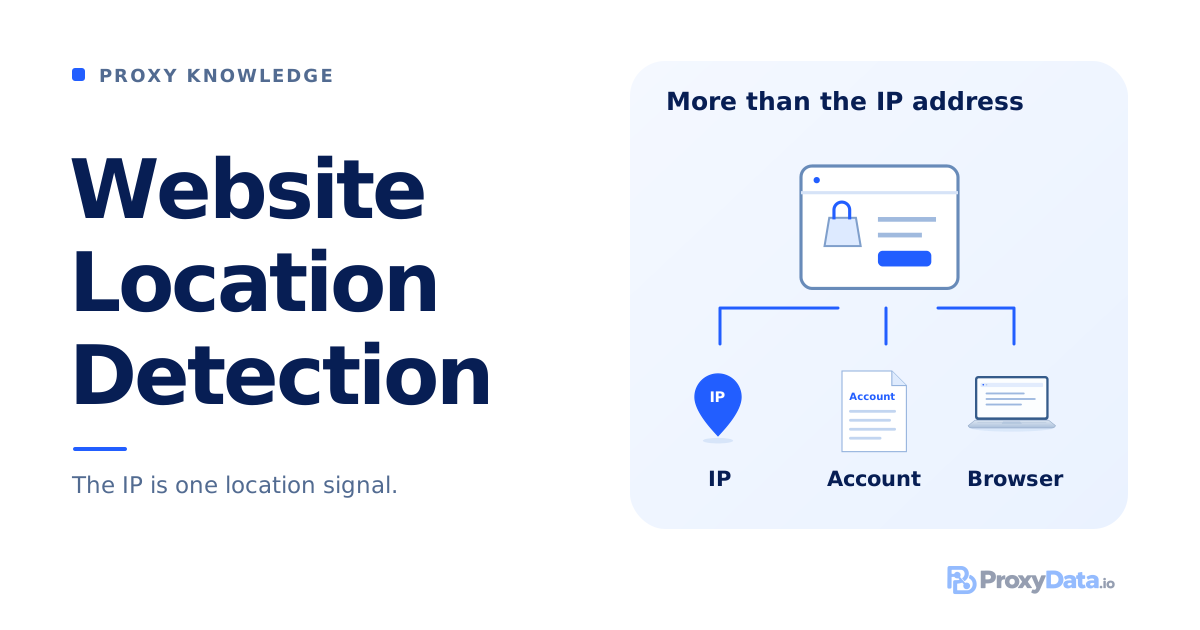
Website location detection is the process a website uses to estimate a visitor's location from the information available to it. The estimate may influence search results, regional content or access decisions. A website can also select a region from an account setting or a delivery address, without treating that region as the visitor's current physical location.
Within Proxy Geolocation & Targeting, choosing a proxy country determines which location you want for the exit IP. A proxy changes the source address of the requests it carries. The website can still receive other information from the browser, the account and the customer.
The country of an IP and the region of a store
Imagine a customer in Vietnam shopping for clothes from a South Korean online store. The customer uses a proxy whose exit IP is identified as South Korean. In this example, the store also identifies the connection as South Korean, yet opens its storefront for Vietnam.
On an earlier visit, the customer selected Vietnam in the store's country menu. This particular store saves that choice for returning visitors. It therefore keeps Vietnam selected and displays the shopping experience configured for that market. The proxy has supplied the expected exit; the store has remembered the customer's preference.
The two country labels answer different questions. The IP result describes the connection. The selected market controls which regional version of the store the customer sees. That selection can affect the catalogue, prices and delivery information. A country name in the page header is therefore not automatically a report about the IP address.
A different explanation applies when a website explicitly assigns the exit IP to another country. The site and an external checker may use different geolocation databases, versions or location estimates. Agreement with a checker cannot establish which data the target site uses. That is a disagreement about the address itself; the shopping example above assumes that both services agree on the IP's country.
Saved preferences and account history
A website can remember a visitor through cookies, small pieces of data stored by the browser and sent back with later requests. A cookie may hold a preference or an identifier that lets the website retrieve information stored on its servers. Other browser storage can also preserve a country selection. Changing the proxy does not automatically remove those records.
Account information can last beyond a browser session. A stored delivery address, preferred market or home location may be attached to the account. Once the customer signs in, the website can associate the visit with those existing details, even from another device. Removing local site data does not erase information kept in the account.
This explains how the same exit IP can produce different regional experiences in an ordinary browser session and a fresh session where the visitor is signed out. The site has different information available in each case. Such a difference suggests that the session or account matters, although it does not reveal the site's complete decision process.
The page being opened also matters. A link to a particular regional storefront can carry that choice into the visit. A selected city in a search box can determine the area being searched. Neither requires the website to locate the customer's device in that place.
Search services illustrate the same broader pattern. Google documents using information such as the connection's IP address, device location, saved places and previous activity when determining a relevant location. A location associated with an earlier search can still be useful to the service. Each website decides which available information to use; there is no universal order in which IP, account and browser data take priority.
Location shared by the device
Web browsers offer a Geolocation API, a feature through which a website can request the device's estimated geographic position. Access requires the user's permission. Depending on the browser and the permission previously granted, the site may be allowed to request a position without showing a new prompt on every visit.
The result can be based on GPS, nearby Wi-Fi networks, mobile network information or other sources available to the device and its location service. A laptop without GPS can therefore still provide a location estimate. The available sources and conditions affect its accuracy.
This information can travel through the proxy along with the rest of the page's requests. Routing a message through a South Korean exit does not change coordinates obtained from a device in Vietnam. The website can receive a Korean source IP and a device position in Vietnam in the same visit.
Blocking access to this browser feature prevents the site from obtaining a new position through that API while access remains denied. The site can still estimate an area from the IP address or use information already associated with the visit. A missing location prompt is not proof that the site has no geographic information.
Language and time zone
A browser usually sends preferred languages with its requests. A page can also use JavaScript to read language preferences and the time zone exposed by the browser. These features do not use the permission prompt for device geolocation.
Language is useful for selecting the text a visitor can read. A Vietnamese speaker visiting South Korea may keep Vietnamese as the browser's preferred language. A Korean storefront could consequently display Vietnamese text, if it supports that language, while correctly assigning the connection to South Korea.
Time zone settings need similar care. They may follow the device's current location, remain set to a previous location or be configured manually. Several countries can share the same UTC offset. A reported time zone is a clue about the browser's settings, with limited value as evidence of where the device physically is.
These observations also limit what can be concluded from a browser checker. A language or time zone that differs from the proxy country does not, by itself, demonstrate an IP leak or explain a blocked account. Knowing which values differ is easier than knowing how a particular website uses them.
Connections outside the proxy
A proxy setting covers the traffic that the application actually sends through it. Loading a page through a proxy does not establish that every other network operation takes the same route.
WebRTC is browser technology for real-time audio, video and data connections. When preparing a connection, it can use network tests to discover available addresses. If the browser permits direct connections outside the proxy, these tests can reveal another public IP, such as the address of the customer's internet connection. This can give the website another address to locate geographically.
Whether that happens depends on the browser's address-handling rules and the permitted network routes. Browsers provide controls that affect what WebRTC exposes. A private local address is also a different kind of result: an address such as 192.168.1.10 is reused in many unrelated networks and cannot identify a country on its own.
DNS translates hostnames into network addresses. Depending on the application and configuration, a lookup may happen locally or through the proxy. A DNS test can report the resolver handling the lookup. The country assigned to that server can differ from both the customer and the proxy; that country alone does not establish the customer's location.
Some resolvers can also send information about part of the client's network address through an optional feature called EDNS Client Subnet. That can disclose more network information than the resolver's own address. The distinction matters: a resolver in an unexpected country and a disclosed client subnet are different findings.
These routes deserve attention when the requirement is that relevant traffic use the proxy. Their existence does not make every unexpected language, currency or storefront evidence of a connection leak.
Geolocation and access decisions
A website can correctly identify the IP's country and still refuse a request. Access rules may consider the address, network, request characteristics or account status. A generic refusal or challenge does not disclose which condition triggered it. Even a location-related message may refer to the account's region or the service's availability in a market.
Shopping adds another decision at checkout. A store may allow browsing from South Korea but offer no delivery for a particular item to Vietnam. The shipping address determines where the parcel must go, regardless of the proxy used to place the order. Some commerce systems also use that address to set the final market, currency or available delivery options.
For the customer, successfully opening the Korean storefront and being eligible to complete an order are separate outcomes. A proxy service can provide the requested connection while the purchase still depends on the store's delivery and account rules.
Replacing an address is relevant when the problem comes from the country the website assigns to that address, or from another rule attached to the address or network. When the displayed region comes from a saved selection, changing IPs may leave the result untouched. The useful distinction is which piece of information the website is acting on: the connection it receives, the visitor it remembers, or the destination the customer has supplied.