
IPv6 Proxies
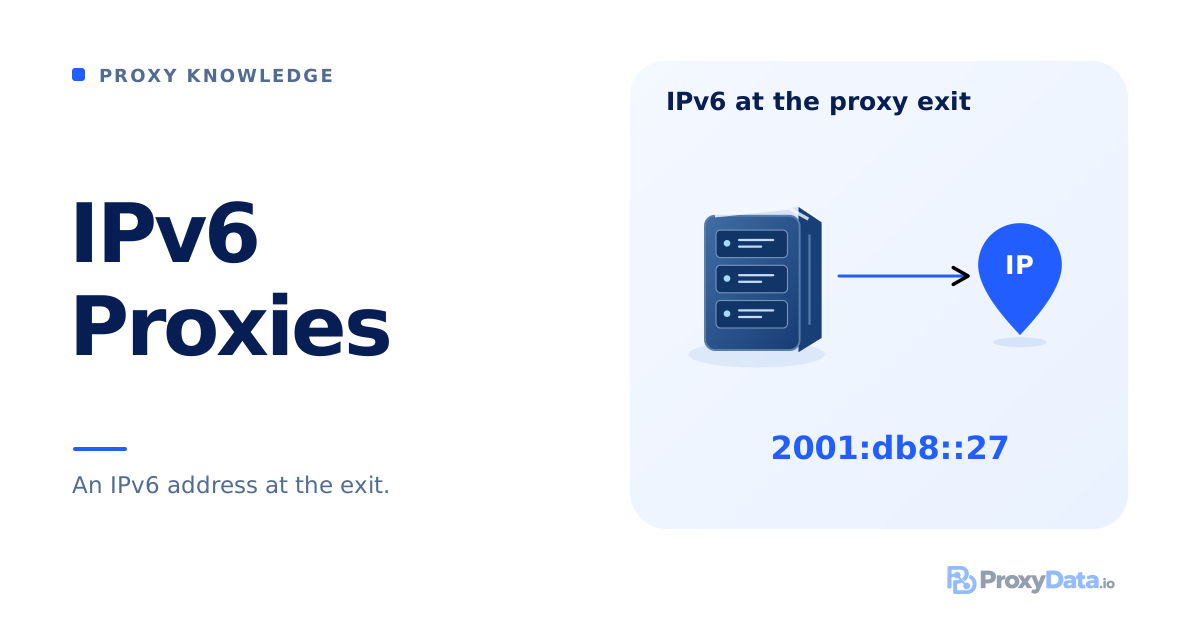
An IPv6 proxy is an intermediary that connects to a website on a client's behalf using an IPv6 address. IPv6 stands for Internet Protocol version 6. Its addresses are 128 bits long and are usually written with numbers, letters, and colons, such as 2001:db8:42:7::27.
For a proxy customer, IPv6 opens up access to large address pools without the same shortage of addresses found in IPv4. The practical questions are whether the destination accepts IPv6 connections and what those addresses provide. The broader comparison is covered in IPv4 vs IPv6 Proxies.
Compare IPv6 proxy providersCompare IP allocation, usage limits, and pricing.View comparisonWhat an IPv6 address looks like
Written out in full, an IPv6 address contains 8 groups of 4 hexadecimal digits, separated by colons:
2001:0db8:0042:0007:0000:0000:0000:0027Hexadecimal uses the digits 0–9 and the letters a–f, which represent the values 10–15. Each group occupies 16 bits. Together, the 8 groups make a 128-bit address.
The same address can be written more compactly. Leading zeros can be removed from each group, so 0db8 becomes db8, and 0027 becomes 27. A consecutive run of zero groups can be replaced with a double colon, ::. Our example becomes:
2001:db8:42:7::27These are 2 ways of writing the same IP. The shorter version still contains 128 bits; only its written form has changed. A double colon can appear only once in an address, so the missing groups can be restored without ambiguity. An application may therefore display an address differently from the provider's list without having changed the assigned IP.
When an IPv6 address appears with a port in a proxy URL, square brackets mark where the address ends:
http://[2001:db8:42:7::27]:8080The address is inside the brackets. The port, 8080, is outside them, after the colon. This matters because colons already separate the groups inside IPv6. A program expecting a familiar IP:PORT string must understand this notation. Programs with separate address and port fields use their own input format.
The addresses in this article come from ranges reserved for documentation. They explain the notation and are not working proxies.
The connection address and the exit address
A customer can buy IPv6 proxies and receive a connection entry that looks like 203.0.113.50:8080. That can be a valid arrangement: the entry identifies the provider's gateway, while the destination receives the connection from an IPv6 exit.
There are 2 connections involved. The application connects to the proxy; the proxy opens a connection to the website. They do not have to use the same IP version. A gateway can accept the customer's connection over IPv4 and contact the destination over IPv6. In this arrangement, the customer's home or office connection does not need native IPv6 access.
An entry that is reachable only over IPv6 is different. The customer needs an IPv6 route to that entry. Software support alone cannot supply the missing network connection.
This distinction also explains why the address pasted into an application may differ from the IP reported by a website. The first is the connection address; the second is the exit address. The provider can use a port, username, or session setting to select an exit behind a gateway.
HTTP and SOCKS5 can both be used with IPv6 destinations. IPv6 describes the address version, while HTTP or SOCKS5 describes how the application talks to the proxy. The service and the application still need to support the chosen combination.
Social media, advertising, and other uses
Static IPv6 proxies are used in social media management, paid advertising, and affiliate media buying, including work with Facebook. Agencies and advertising teams use them alongside separate browser work profiles for different client projects. In traffic arbitrage, where paid traffic is intended to earn revenue through leads or sales, the cost of maintaining many such workspaces matters.
A static exit lets a work profile keep the same source IP across visits. The practical arrangement is to keep that address assigned to the profile throughout its ongoing work, while adding more addresses as new projects start. Static describes the service's assignment policy: it is a feature to choose when the task needs consistency.
Fresh address supply is another attraction. Providers can issue previously unused IPv6 addresses from their ranges. Such an IP has no earlier proxy tenant's activity attached to that individual address. This gives the buyer access to new inventory without repeatedly taking over the same heavily reused IPs. The reputation of the surrounding range remains a separate matter, explained below.
The low cost per address makes large batches affordable. A team can keep spare capacity, add exits for new client work, or replace retired assignments without the same address costs associated with building a large IPv4 list. Cheap expansion and a stable IP for each ongoing profile can go together; a large supply does not require constant rotation.
Before committing to a large batch for social media or advertising, a small sample can be tried in the actual browser or work tool. The useful test covers the required login, dashboard, and other destinations. A green result from an IP checker alone does not show that the full working session succeeds.
IPv6 proxies can also be useful for collecting public information from destinations that accept IPv6, including repeated price, availability, or search-result requests. A large pool offers room to assign different exits to separate workers or tasks. The benefit is economical access to many source addresses; the target's access rules and the service's connection capacity still govern the work.
They are also useful for testing a website or application through IPv6 from another network. This can reveal a service that works from the developer's usual connection but fails on its IPv6 route, or behaves differently for IPv6 visitors. A proxy provides an external point from which to observe that behavior.
For regional checks, an IPv6 exit can provide a source address associated with the required location. The location and network type must come from the actual service: an IPv6 address can belong to a datacenter, household connection, internet provider, or mobile network. Its length does not identify which of those the customer has bought.
Website compatibility
An IPv6 exit needs a destination reachable over IPv6. For a hostname, the Domain Name System, or DNS, normally supplies that address in an AAAA record. The familiar A record supplies an IPv4 address. A hostname can have either type or both.
The address passed to the proxy matters too. If the application supplies only a resolved IPv4 destination, it has not asked for a connection to the site's IPv6 endpoint. Passing the hostname lets a capable proxy resolve and select that endpoint itself.
This is why an IPv6 proxy can work on an IP-checking website and fail on the service the customer actually needs. The checker has demonstrated a connection to itself. It has not established that another destination is reachable over IPv6.
Support can also differ within one service. A main website may accept IPv6 while a separate login host or data API accepts only IPv4. A successful visit to the homepage therefore does not establish that every part of a browser session or automated task will work through an IPv6-only exit.
A service that supports both address versions is called dual stack. Depending on its settings, a proxy may use IPv6 where available and fall back to IPv4 elsewhere. A provider can also offer a translation path between the versions. In either case, an IPv4-only destination receives an IPv4 connection and sees an IPv4 source address. The advertised IPv6 pool does not become a pool of distinct IPv4 exits.
Without an available IPv4 path, a proxy restricted to IPv6 cannot directly reach an IPv4-only destination. This limitation is separate from whether its password, port, or assigned address is correct.
Why IPv6 address pools can be large
An offer containing a million IPv6 addresses does not require a million proxy servers. A provider can serve many addresses from an assigned block through the same infrastructure.
An address block is described by a prefix: the starting bits shared by all its addresses. For example, 2001:db8:42:7::/64 fixes the first 64 bits and leaves the remaining 64 bits available for different values. That gives this one block about 18.4 quintillion possible address values. This is a calculation of address capacity, not a count of running proxies.
The provider needs the right to use the block, a route that delivers its traffic, and a working proxy service. It can then supply many distinct exits without obtaining another scarce IPv4 address for each one. This helps explain how an IPv6 offer can have a low price per address even when the list is very large.
The customer is paying for usable access through that infrastructure. The size of the address block does not say how many exits the plan exposes, how many connections it accepts, or how much traffic it can carry. A subscription can provide a fixed list, a limited rotating pool, or access to a larger block under defined service limits.
Network prefixes and IP reputation
Consider these 2 exit addresses:
2001:db8:42:7::27
2001:db8:42:7::98
They are different IPs, but both belong to 2001:db8:42:7::/64. They can share the same provider, server, and route. Changing the final part of an IPv6 address does not necessarily move the customer to another network.
That matters when a website applies restrictions to an address range. If a rule covers this entire /64, both exits fall within it. Generating another address inside the same block leaves it inside the same rule. Websites can also make decisions about larger networks, rather than treating every full IPv6 address independently.
A previously unused address can still belong to a recognized hosting network or a range with a poor reputation. A dedicated assignment gives the customer exclusive use under the service's terms; it does not erase the network's history. Conversely, belonging to a large IPv6 range does not itself make an address suspicious.
For the buyer, a large address count and a varied network selection are different benefits. More addresses from one prefix do not provide the same variety as exits from different networks and locations.
Static and rotating IPv6 proxies
IPv6 can support either a stable address or changing addresses. Its large address space gives the provider room to offer both. It does not require every proxy to rotate.
A static service keeps an assigned exit available for the agreed period. This suits tasks that need a consistent source address across related requests. A rotating service selects changing exits according to its rules, which may involve a new connection, a time interval, or a customer-controlled change.
The distinction between a request and a connection matters here. An ordinary TCP connection keeps the same pair of network endpoints throughout its lifetime. If several web requests reuse that connection, they can retain the same exit IP. Rotation for each request therefore requires the service to manage outgoing connections accordingly; the supply of IPv6 addresses alone does not provide it.
A rotating service can also offer a sticky session, holding the selected exit for a period. Availability, duration, and replacement behavior belong to the service plan. Changing an IP does not, by itself, clear browser cookies or start a new website account session.
Performance and encryption
Address length alone does not tell a customer whether a proxy will be faster or slower. The route, available bandwidth, server load, and destination response affect the result. Thousands of IPv6 exits can share one server and one network connection, so increasing the number of addresses does not by itself increase throughput.
The figure of 128 bits describes the address length. It is not a 128-bit encryption key. IPv6 does not automatically encrypt proxy traffic: protection comes from the protocols actually used, such as HTTPS for an encrypted connection to a website. Choosing IPv6 does not replace those protections.